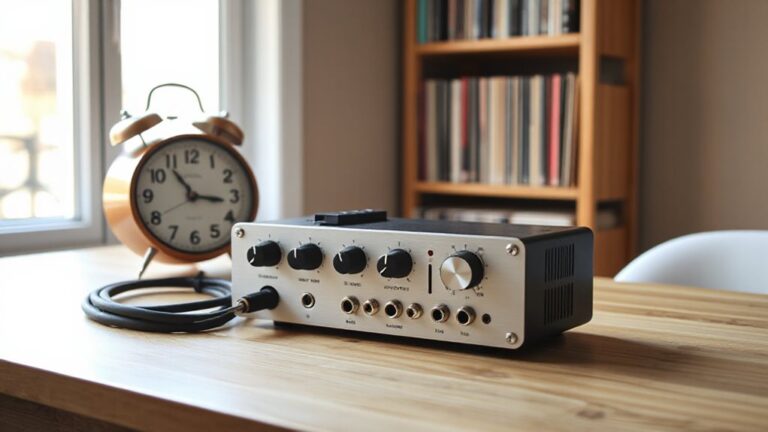
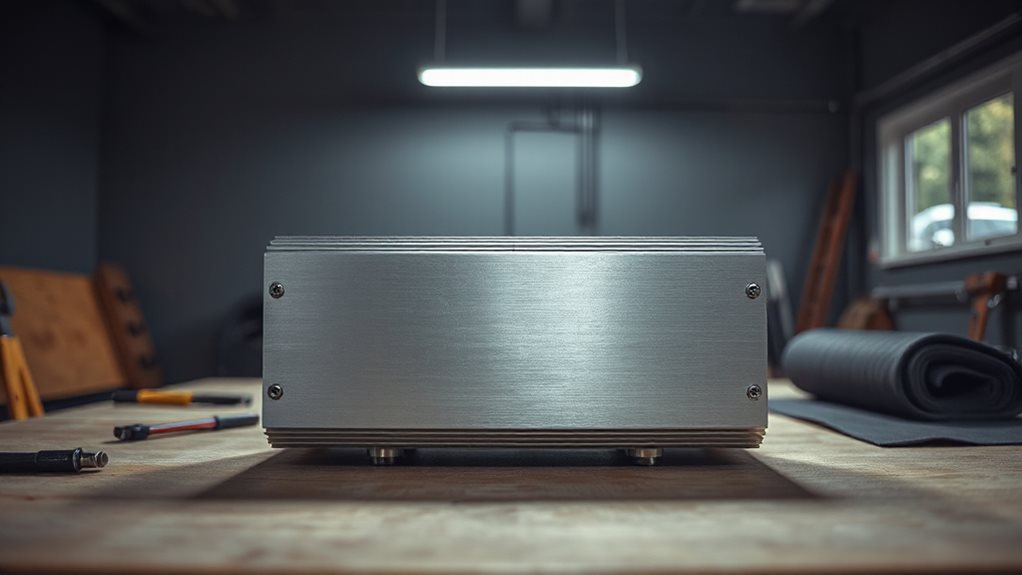
You’re blasting your favorite track, and the factory amp just can’t keep up. Sound cracks, power fades.
That’s where a strong 4-channel amplifier steps in. The Orion Cobalt CBA2000.4 handles wild lows, clean highs, and stays cool under pressure.
You want power, clarity, and space for growth. These seven amps deliver.
Each one balances strength, smart design, and real-world performance.
Pick the right one, and your music doesn’t just play—it moves.
Quick Overview
- High-power 4-channel amps like the Crunch PDX-1000.4 deliver up to 250W per channel at 2Ω for robust, distortion-free audio performance.
- Class A/B amplifiers such as the Orion Cobalt CBA2000.4 offer superior sound clarity with efficient heat dissipation via aluminum heatsinks and thermal protection.
- Low THD and high signal-to-noise ratios, like Skar Audio’s 105 dB, ensure clean, accurate sound reproduction across all frequencies.
- Flexible input options, including RCA and high-level inputs, allow easy integration with factory or aftermarket head units on models like Orion and Skar.
- Compact, lightweight designs with bridgeable channels support versatile installation and mono subwoofer use without sacrificing performance.
| Orion Cobalt CBA2000.4 4-Channel Car Amp |  | Best Overall | Power Class: Class A/B | RMS Power at 4Ω: 50W × 4 | RMS Power at 2Ω: 80W × 4 | VIEW LATEST PRICE | Read Our Analysis |
| Crunch PDX-1000.4 1000W 4-Channel Car Amplifier |  | Best Value | Power Class: Analog (SEPP) | RMS Power at 4Ω: 125W × 4 | RMS Power at 2Ω: 250W × 4 | VIEW LATEST PRICE | Read Our Analysis |
| Crunch Ground Pounder GP-1500.4 1500 Watt 4 Channel Amplifier |  | High-Power Performer | Power Class: Not specified | RMS Power at 4Ω: 185W × 4 | RMS Power at 2Ω: 375W × 4 | VIEW LATEST PRICE | Read Our Analysis |
| Pioneer GM-A4704 4-Channel Car Amplifier |  | Budget-Friendly Pick | Power Class: Class AB | RMS Power at 4Ω: 40W × 4 | RMS Power at 2Ω: Not specified | VIEW LATEST PRICE | Read Our Analysis |
| Recoil DI550.4 4-Channel Car Amp |  | Compact Powerhouse | Power Class: Class D | RMS Power at 4Ω: 80W × 4 | RMS Power at 2Ω: 130W × 4 | VIEW LATEST PRICE | Read Our Analysis |
| Orion Cobalt CBA2500.4 4-Channel Car Amp |  | Editor’s Choice | Power Class: Class A/B | RMS Power at 4Ω: 60W × 4 | RMS Power at 2Ω: 100W × 4 | VIEW LATEST PRICE | Read Our Analysis |
| Skar Audio RP-150.4AB 4-Channel Amplifier |  | Premium Build Quality | Power Class: Class A/B | RMS Power at 4Ω: 125W × 4 | RMS Power at 2Ω: 250W × 4 | VIEW LATEST PRICE | Read Our Analysis |
More Details on Our Top Picks
Orion Cobalt CBA2000.4 4-Channel Car Amp
You want power that hits hard and clean, like a drumbeat under your seat. The Orion Cobalt CBA2000.4 delivers just that.
It pushes 80 watts RMS per channel at 2 ohms, so your speakers get strong, steady juice. Class A/B means rich sound without overheating. You’ll hook up with RCA or high-level inputs—either works.
Adjust crossovers, add bass boost, and lock in protection circuits. At 2Ω or 4Ω, it stays stable. Compact size fits tight spaces.
Just wire it right, give it 12 volts, and feel the beat take over—clean, loud, and in control.
- Power Class:Class A/B
- RMS Power at 4Ω:50W × 4
- RMS Power at 2Ω:80W × 4
- Impedance Stability:2/4 Ohm stable
- Protection Circuitry:2-Way Protection
- Crossover Type:Adjustable Low-Pass, High-Pass
- Additional Feature:Bass Boost feature included
- Additional Feature:Supports high-level inputs
- Additional Feature:MOSFET power supply
Crunch PDX-1000.4 1000W 4-Channel Car Amplifier
A powerhouse in compact form, the Crunch PDX-1000.4 delivers serious punch for car audio lovers who demand clean, customizable sound. You get 125 watts per channel at 4 ohms, crisp, clear, and strong. Push it to 2 ohms? Boom: 250 watts per channel, doubling the energy. Its SEPP analog design cuts distortion, so music stays true.
Twist the dials. Dial in highs. Shape lows. Tune it just right. RCA inputs link easily, letting you build your system your way. Thermal, overload, and short-circuit guards keep it safe, always. Blue finish shines under dash lights, style meets muscle. You control the rhythm. You own the road.
- Power Class:Analog (SEPP)
- RMS Power at 4Ω:125W × 4
- RMS Power at 2Ω:250W × 4
- Impedance Stability:2/4 Ohm stable
- Protection Circuitry:3-Way Protection (thermal, overload, short-circuit)
- Crossover Type:Fully Adjustable 24dB Crossovers
- Additional Feature:SEPP analog amplifier design
- Additional Feature:Fully adjustable 24dB crossovers
- Additional Feature:Exclusive blue finish
Crunch Ground Pounder GP-1500.4 1500 Watt 4 Channel Amplifier
Bass that hits like thunder, crisp highs that slice through the mix. This is the sound of the Crunch Ground Pounder GP-1500.4, a 4-channel amplifier built for drivers who demand power without compromise.
You push play, and it delivers 375 watts per channel at 2 ohms, clean and strong. Bridge it, and two channels pump out 750 watts, perfect for subs. Its crossover sharpens your sound, cutting clutter with 12 dB precision.
At 10.75 inches long, it fits tight spaces, yet weighs just 5.4 pounds—solid, not bulky. You’ll wire it fast, mount it easy, and feel the difference immediately. This amp doesn’t just play music. It commands it.
- Power Class:Not specified
- RMS Power at 4Ω:185W × 4
- RMS Power at 2Ω:375W × 4
- Impedance Stability:2/4 Ohm stable
- Protection Circuitry:Not specified
- Crossover Type:Variable Electronic Crossover (12 dB/octave)
- Additional Feature:4-channel bridged mono modes
- Additional Feature:Variable 12 dB/octave crossover
- Additional Feature:9V max supply voltage
Pioneer GM-A4704 4-Channel Car Amplifier
Solid power meets smart design in the Pioneer GM-A4704, a 4-channel amplifier built for drivers who want control without compromise. You get 40 watts RMS per channel—clean, strong, reliable. Bridge it, and boom: 130 watts to two channels, perfect for front speakers or a sub. Class AB efficiency keeps heat low, so it runs cool, day after day. You’ll hear every note, crisp and clear, with minimal distortion.
Tweak highs with the high-pass filter, shape lows with the low-pass—tune it your way. Rock, hip-hop, jazz? It handles all. Compact. Tough. Smart. You command the sound. This amp obeys.
- Power Class:Class AB
- RMS Power at 4Ω:40W × 4
- RMS Power at 2Ω:Not specified
- Impedance Stability:2/4 Ohm stable (bridgeable)
- Protection Circuitry:Not specified
- Crossover Type:Variable High-Pass and Low-Pass Filters
- Additional Feature:Bridgeable for subwoofer integration
- Additional Feature:Minimized crossover distortion
- Additional Feature:Variable high-pass/low-pass filters
Recoil DI550.4 4-Channel Car Amp
You’re building a system that craves power without the bulk, and the Recoil DI550.4 steps in like a tuned engine, lean, strong, and ready. It pushes 80 watts RMS per channel at 4 ohms, jumps to 130 at 2. Stable. Efficient. Built tough.
Its MOSFET supply sips power, while the heatsink keeps things cool, even when you run it hard. You adjust gain, set high- or low-pass filters, or bridge channels for 260 watts to two subs. Compact? Yes—just 7.48 inches long. But don’t let size fool you. This amp delivers clean, punchy sound, song after song, with protection circuits guarding every beat.
- Power Class:Class D
- RMS Power at 4Ω:80W × 4
- RMS Power at 2Ω:130W × 4
- Impedance Stability:2-4 Ohm stable
- Protection Circuitry:4-Way Protection
- Crossover Type:Adjustable LPF, HPF, Crossover Settings
- Additional Feature:Compact form factor
- Additional Feature:Bass EQ control
- Additional Feature:High-speed MOSFET supply
Orion Cobalt CBA2500.4 4-Channel Car Amp
When your music demands more muscle, the Orion Cobalt CBA2500.4 steps in like a steady heartbeat beneath the dashboard, strong, reliable, and ready to drive every speaker with precision. You’ll love its 100W RMS power per channel at 2 ohms, pushing clean sound through all four speakers without strain. It handles 2- or 4-ohm loads, so you can customize your setup easily.
With adjustable high- and low-pass crossovers plus bass boost, you shape your sound just right. The Class A/B design runs cool, resists noise, and delivers rich, full audio. Plug in via RCA or high-level inputs—either way, the signal stays strong, clear, and steady.
- Power Class:Class A/B
- RMS Power at 4Ω:60W × 4
- RMS Power at 2Ω:100W × 4
- Impedance Stability:2/4 Ohm stable
- Protection Circuitry:2-Way Protection
- Crossover Type:Adjustable Low-Pass, High-Pass
- Additional Feature:Robust metal casing
- Additional Feature:High-efficiency thermal design
- Additional Feature:Supports RCA and high-level inputs
Skar Audio RP-150.4AB 4-Channel Amplifier
The Skar Audio RP-150.4AB isn’t just another amplifier, it’s your ticket to deep bass and crisp highs, perfect for drivers who want power without the bulk. You get 250 watts RMS per channel at 2 ohms—serious juice.
It handles 4-ohm and 2-ohm loads with ease, so your speakers sing clean. The frequency response hits every note from 20 Hz to 20,000 Hz. Signal-to-noise? 105 dB—quiet background, pure sound.
Class A/B design saves energy. 4-way protection keeps it safe. Big 4-gauge power terminals mean strong, steady flow. Plug in, turn up, and feel the rhythm ride right.
- Power Class:Class A/B
- RMS Power at 4Ω:125W × 4
- RMS Power at 2Ω:250W × 4
- Impedance Stability:Not explicitly stated, but supports 2Ω and 4Ω
- Protection Circuitry:4-Way Protection
- Crossover Type:Not specified
- Additional Feature:105 dB signal-to-noise ratio
- Additional Feature:4-gauge power terminals
- Additional Feature:Class A/B MOSFET design
Factors to Consider When Choosing 4-Channel Car Amplifiers
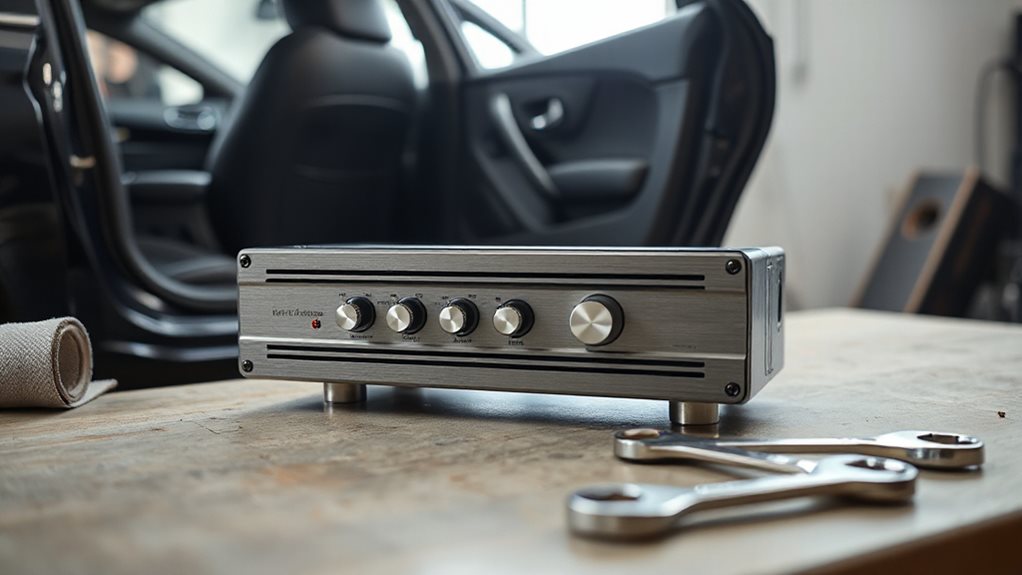
You need power that matches your speakers, so check the amplifier’s output before you buy. Choose a 4-channel amp with flexible wiring options and make sure it works with your car’s speaker impedance. Most run at 2 or 4 ohms.
Look for clean signal features like low-pass filters, solid heat sinks, and quiet cooling fans to keep your music loud, clear, and distortion-free.
Power Output Requirements
Though power might seem like just a number, it’s actually the heartbeat of your sound system. Getting it right starts with understanding RMS ratings, such as 80 watts per channel at 4 ohms, because that’s the real measure of steady, reliable performance.
You need clean power, not flashy peaks. Pick an amp stable at both 4 and 2 ohms. That way, you can safely run more speakers or lower-impedance loads. When your amp delivers higher RMS at 2 ohms, you gain serious punch, perfect for driving multiple speakers.
Use bridged mode to double the power to one channel. This is ideal for subs or loud front speakers. Match this with a wide frequency response, say 10 Hz to 30 kHz, so highs stay crisp, and lows stay deep.
You’re not just adding volume, you’re fueling clarity, control, and force. Choose smart. Build strong. Let your music move.
Channel Configuration Options
Power shapes your sound, but how you route it defines your system’s soul. You’ve got four channels, use them wisely.
Run all four to power front and rear speakers for crisp, balanced stereo. Or bridge two channels to drive a subwoofer in mono, doubling power where you need it most. Many 4-channel amps let you switch modes on the fly: 4-channel stereo, dual mono, or a mix.
Match tweeters up front with clean highs. Send bass-heavy mids to rear speakers, and slam a sub with bridged power. Set adjustable crossovers to block low frequencies from small speakers. Choose 2-ohm stable models to push more juice to demanding setups.
Flexibility means control. You’re not stuck in one layout. Adapt to your ride, your music, your mood. Smart routing turns good sound into great sound.
Impedance Compatibility Check
When your speakers and amplifier speak the same electrical language, everything clicks: clean highs, punchy mids, and bass that hits hard without a hitch. Match your amp’s stable impedance with your speakers’ nominal rating, usually 2 or 4 ohms. If your amp says “2/4-ohm stable,” you’re golden for more setups.
Go lower than rated? Danger. Overheating. Shutdowns. Damage. A 2-ohm load pulls more current, so beef up your wiring and power supply. Too high? You’ll waste power and miss volume.
Mismatched gear means weak sound or protection circuits kicking in. Always check both specs, amp and speakers, before wiring. It’s not just about power, it’s about harmony. Get it right, and your music flows smoothly, loudly, and clearly. Get it wrong, and you’re stuck with crackles, cuts, and costly fixes.
Signal Quality Features
What makes your music sound crisp, clean, and alive? It’s the signal-quality features hidden inside your amp. You want a high signal-to-noise ratio, 105 dB or more, so background hiss stays gone. Low total harmonic distortion (THD) keeps vocals sharp and instruments true, not muddy or fake.
Aim for full frequency response: 20 Hz to 20,000 Hz. That covers every bass thump, midrange voice, and high-hat shimmer humans can hear. Use adjustable crossovers to send just the right frequencies to each speaker. Tweeters get highs. Woofers get lows. Clean split. Less distortion. More clarity.
And pick an amp with both RCA and high-level inputs. That way, you hook it up to any head unit without losing signal strength. You stay flexible. You stay in control. Your music stays pure.
Heat Management Systems
Even with the music cranked, your amp shouldn’t run like a feverish engine. You need smart heat management to keep power steady and parts safe. Look for aluminum heatsinks; they pull heat away fast. Finned metal casings boost cooling by spreading warmth into the air.
Class A/B amps run hotter than Class D, so they need stronger cooling. That’s where 4-way protection helps: thermal shutdown kicks in before damage happens. You want high-speed thermal materials inside; they move heat like a sprinter.
Give your amp space. Let air flow around it. Add a fan if needed. Solid ventilation means longer life and steady performance.
Smart design means cool operation, even at full blast. Pick an amp that breathes well. Let it stay chill. Let it deliver. Every beat counts: keep the system cool, and the sound stays clean.
Installation Flexibility Options
If your car’s audio setup has to adapt, so should your amplifier. You want freedom and flexibility to fit any vehicle, any dash, any dream. Pick an amp with both RCA and speaker-level inputs. That way, you’re ready whether your factory system stays or goes.
Need to power two speakers and a sub? Bridge channels into mono mode. It’s smart. It’s simple. Compact size and light weight mean you can tuck it under a seat or slide it behind a panel, no sweat.
Surface-mount design with standard screw holes. Just bolt it down flat and secure. No custom brackets. No hassle. Ohm stability at 2 or 4 ohms lets you run multiple speakers per channel without fear. Mix. Match. Make it yours. Your car. Your rules.
Installation isn’t a puzzle. It’s a plan. And this amp? It’s the key.
Frequently Asked Questions
Can I Install a 4-Channel Amp Myself?
Yes, you can install a 4-channel amp yourself. Plan, prep, and protect. Always disconnect the battery.
Run power from the fuse box, ground to bare metal, and route RCA cables away from power lines. Connect speaker wires neatly, match channels to speakers, and double-check connections.
Power up, test, tweak. You’ve got this. It’s satisfying, smart, and totally doable with focus and care.
Do 4-Channel Amps Work With Factory Stereos?
Yes, you can run a 4-channel amp with your factory stereo. Just grab a line output converter; it turns speaker wires into RCA signals. Plug those into your amp’s inputs. Power it up with solid ground and fused power wire. Tune gains carefully.
Factory decks lack pre-outs, but this trick works every time. You’ll hear richer mids, tighter highs, and deeper bass. Clean signal flows. Volume stays smooth. Your music? It’ll punch harder, breathe easier, sound alive.
How Do I Know if My Car Needs a 4-Channel Amp?
You need a 4-channel amp if your car’s sound feels flat and weak. You want crisp highs, punchy mids, and doors that vibrate with bass. Your factory stereo plays music, but it doesn’t drive it.
Add an amp to power all four speakers cleanly. You’ll hear details you never caught before. Clean power means louder, richer sound without distortion.
You’re ready. Upgrade. Transform your daily drive into a rolling concert.
Will a 4-Channel Amp Drain My Battery?
You bet it won’t drain your battery if set up right. Treat your amp like a hungry engine—it needs fuel, but only sips when tuned well. Wire it clean, match your stereo, and fuse it properly.
A 4-channel runs smooth, not wild. Your battery handles it fine, day in, day out. No surprise flat mornings. Keep it tight, keep it right, and you’re golden.
Are 4-Channel Amps Compatible With Subwoofers?
Yes, you can run a subwoofer with a 4-channel amp. Bridge two channels to power it, just like linking arms for strength. Your front speakers stay crisp on the other two.
Match impedance, though. A 4-ohm sub works best with stable 2-ohm bridged amps. Wire it right, and you’ll feel deep, clean bass. Don’t rush. Double-check connections. Solid power flows when everything’s tight, balanced, and built to last.