A smart pet feeder or camera gets bought for one of two reasons: guilt about being away too much, or a genuine scheduling problem, an irregular work shift, a pet on a vet-directed feeding plan, a household that just can’t be home at noon every day. The category delivers on both, but the reliability details that actually matter get buried under camera resolution and app screenshots in most buying guides.
Here’s what actually determines whether a feeder works when you’re not there to notice it failed, what a pet camera is genuinely good for, and the legal wrinkle that shows up specifically when you use one to keep an eye on a sitter or dog walker.
What an Automatic Feeder Actually Solves (and What It Doesn’t)
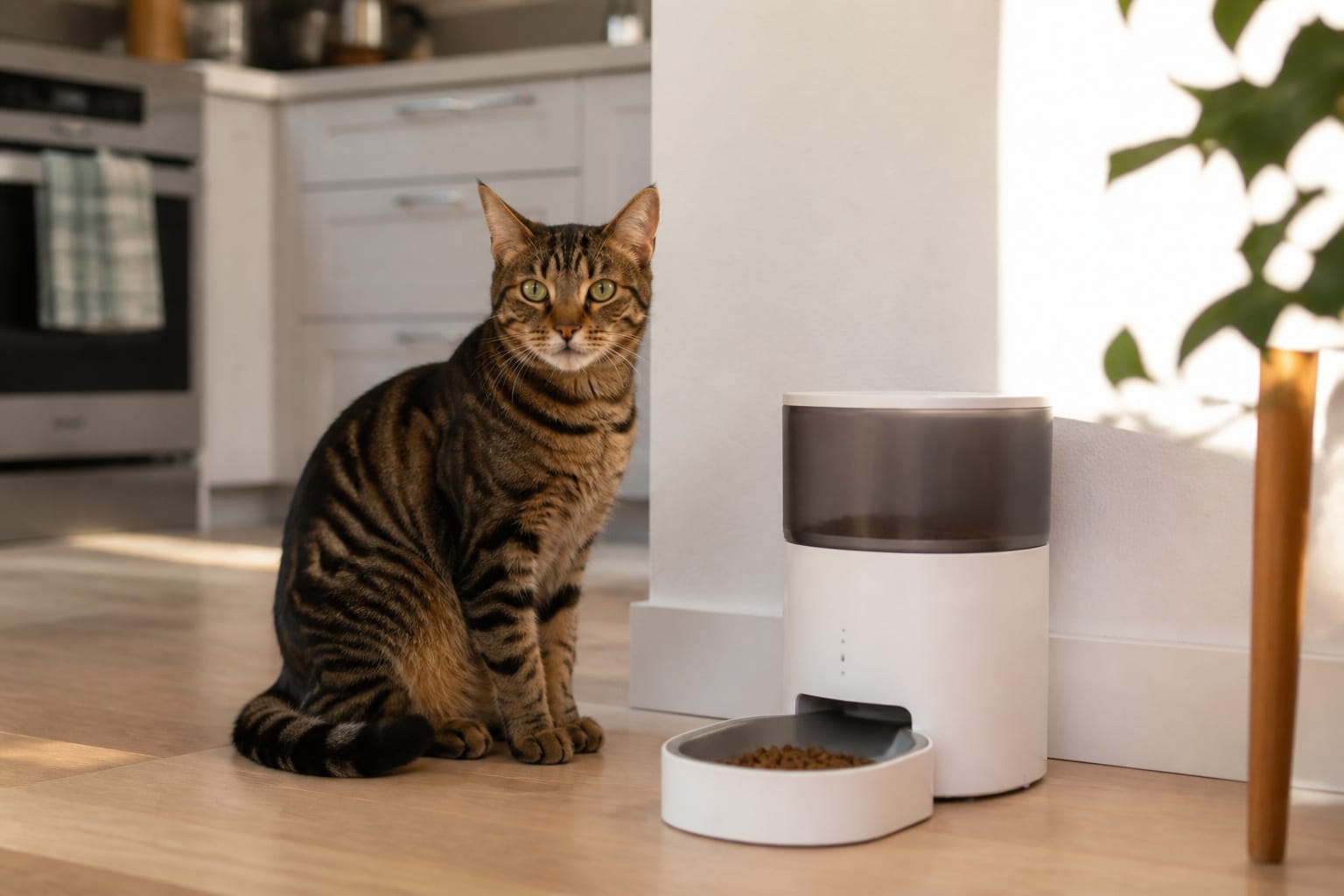
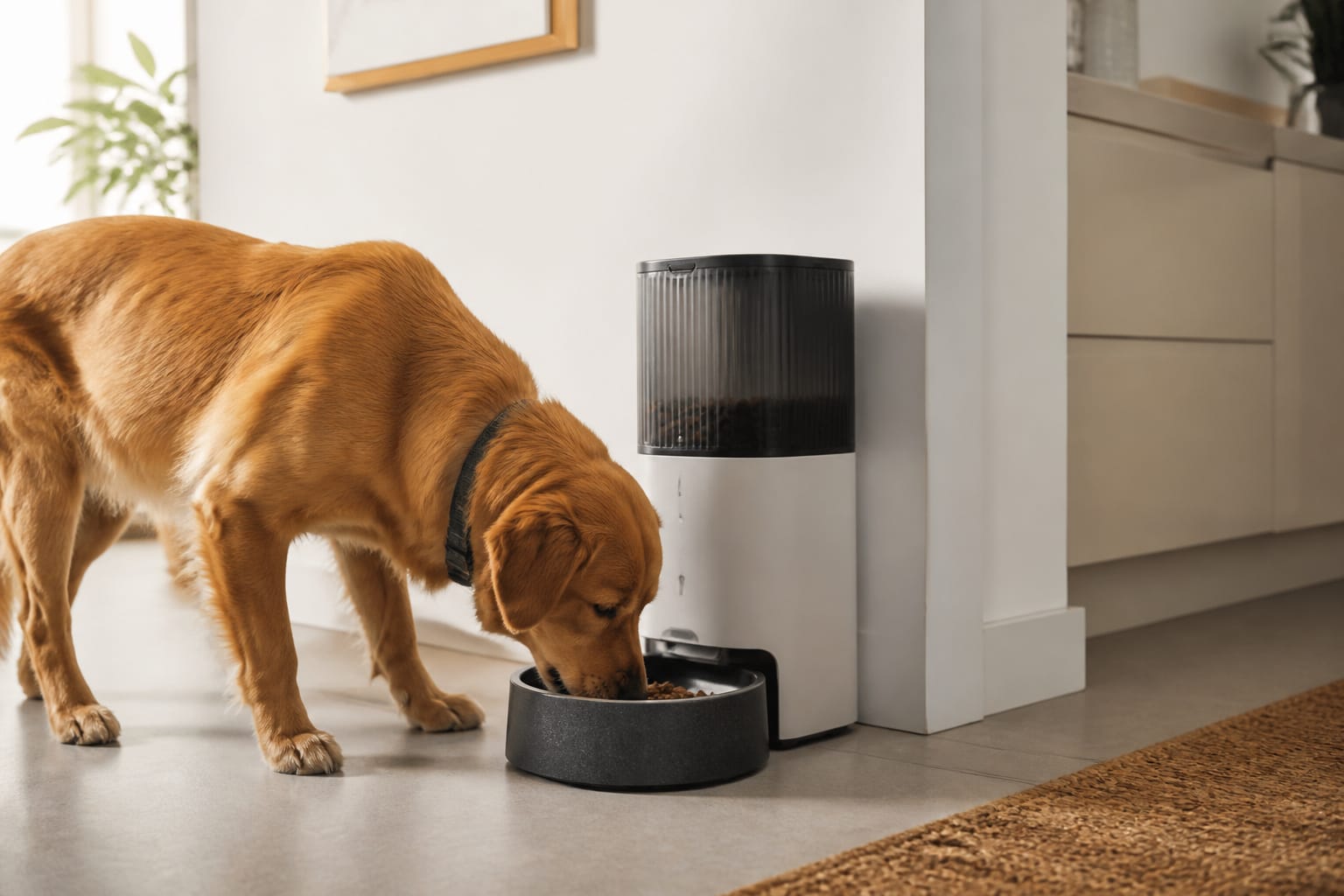
An automatic feeder solves a real, specific problem: consistent timing and portion size when a human isn’t there to deliver it, whether that’s a long workday, an early flight, or a vet-directed feeding schedule for weight management or a medical condition.
It does not solve the underlying need for daily attention. Every credible source in this category, including veterinary technicians who review the products, says the same thing: an automatic feeder is a supplement to care, not a substitute for someone checking on the animal, refreshing water, and noticing if something’s wrong. It’s also not a reasonable tool for anything beyond an overnight absence; a jam or a dead battery quickly becomes a real welfare problem if no one checks in.
Most models handle only dry kibble; wet food spoils too quickly for anything beyond a same-day timed release, and only a small subset of feeders do it. If wet food is part of your pet’s diet, check specifically for that capability rather than assuming a general-purpose feeder will handle it.
Products Worth Considering

【Smooth feeding, No food blockage】-Have you encountered any issues with the food cardholder not coming out while using the feeder? Are you still troubled by constantly shaking the feeder to let food flow out? Our automatic pet feeder comes with a food distribution system that ensures smooth and even feeding of food into the feeding bowl during the automatic feeding program. The detailed design and comprehensive functionality can free up your hands and time, allowing you to no longer worry about pet feeding.
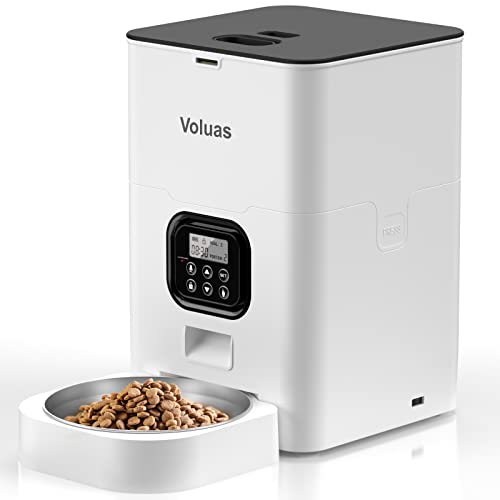
Easy Programmable Feeding Times: Reliably feed your beloved pet at your convenience any time during the day or night; Set between 1-4 meals with 0-40 portion choices to automatically dispense food to give a personal customized diet for your pet. Each portion dispenses approximately 6-7g (1 portion≈ 1tbsp≈ 1/16 cup), making it easy to customize your pet's daily food intake

Programmable Feeding Schedule – Set up to 6 meals per day to support your pet’s healthy diet and prevent overeating.
Portion Accuracy and Jamming: The Detail That Determines Reliability
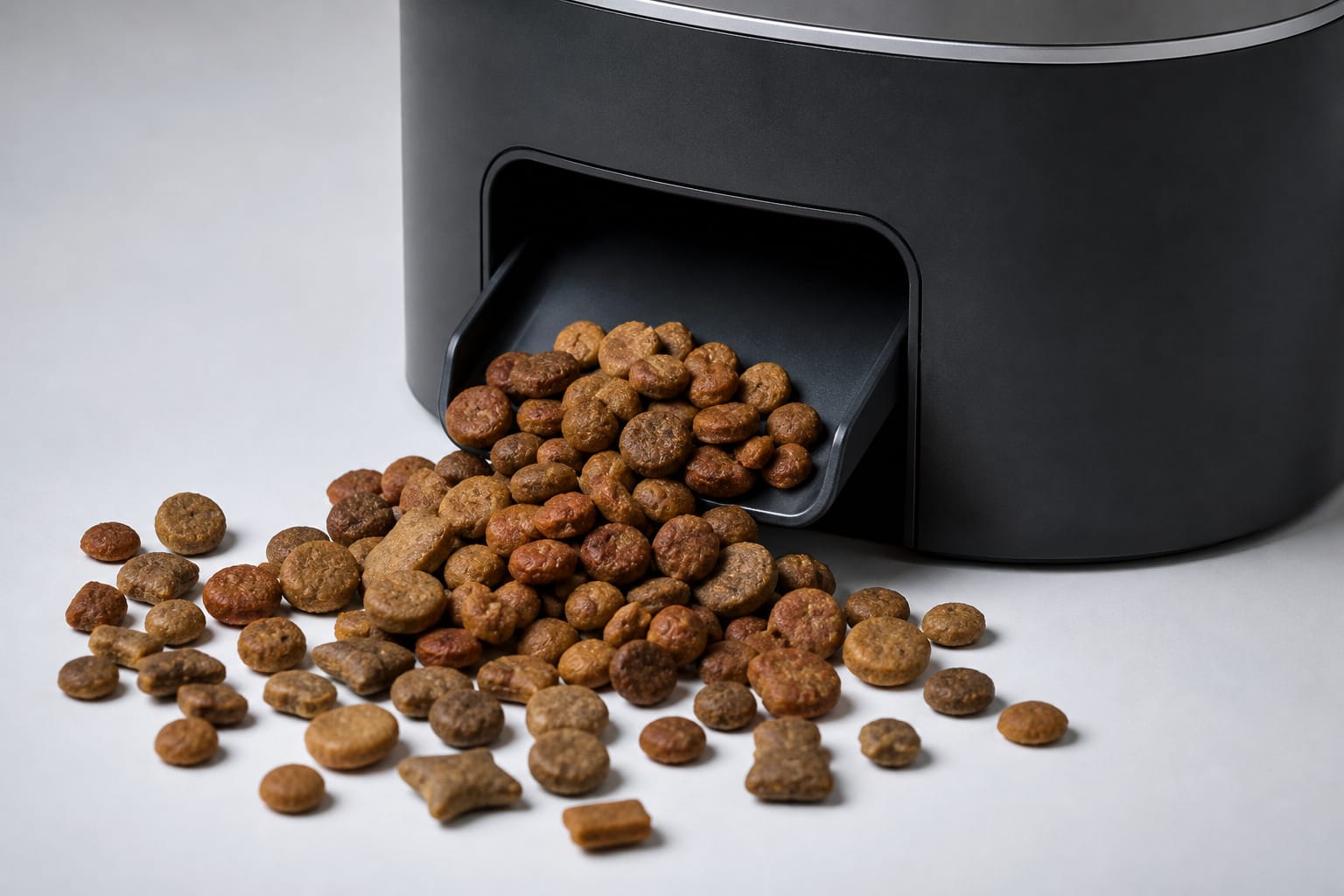
This is the single biggest differentiator between a feeder that works reliably and one that doesn’t, and it has almost nothing to do with the app or the brand name.
Kibble size and shape relative to the feeder’s dispensing mechanism is the main variable: round, uniformly sized kibble flows smoothly through most designs, while oversized, star-shaped, or irregular kibble is what actually causes jams, motor strain, and missed meals.
If you feed a large-breed dog food with big or unusually shaped pieces, confirm a specific feeder’s maximum kibble size before relying on it while you’re away.
How a feeder measures a portion matters too. Volume-based (scoop or rotor) mechanisms are the norm and work fine for most healthy pets at a stable weight, but they’re inherently less precise than weight-based models with a built-in scale, since kibble density varies by brand and even by bag.
For a pet on a veterinarian-directed weight management or medical diet, where an accurate gram count matters, a weight-based feeder is worth the added cost over a standard volume-based one.
Products Worth Considering

Slower eating: Food-grade silicone insert fits inside the stainless-steel dog bowls, helping your pet eat at a more moderate pace

🐾 Durable & Built to Last - Made from thick, heavy-duty plastic that resists cracking, chewing, and everyday wear -perfect for even the most enthusiastic eaters and drinkers.

Small pet-food dispenser for dog or cat; uses gravity to ensure a consistent supply of kibble
Battery Backup and Wi-Fi Dependence: Why “Smart” Needs a Backup Plan
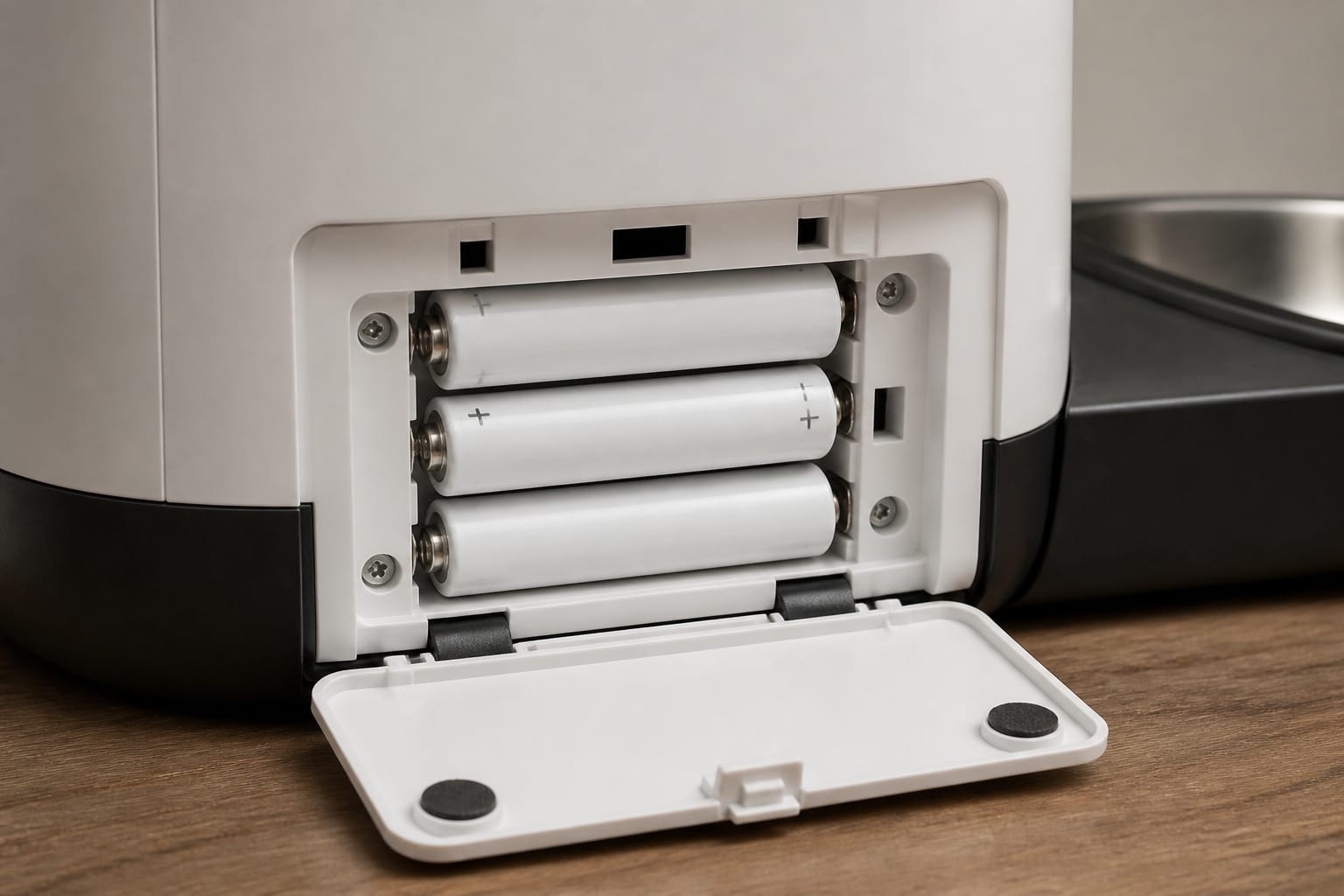
A power outage or dropped Wi-Fi connection is exactly the kind of failure that happens while nobody’s home to notice, which is precisely when a feeder matters most.
Battery backup, independent of the main power connection, is non-negotiable for any feeder you actually plan to rely on; without it, a brief outage can mean a missed meal with no warning. Most reliable models schedule feedings locally on the device rather than on a live internet connection to trigger each meal. Wi-Fi is used only for remote monitoring, app notifications, and schedule changes.
Check that the model you’re looking at handles this before buying; a feeder that genuinely can’t dispense a scheduled meal without an active internet connection is a much bigger liability than one that can.
Multi-pet households add another failure mode: a single feeder in a shared space doesn’t prevent a food-motivated pet from eating a housemate’s portion. Microchip-activated feeders that open via a specific pet’s chip or collar tag solve this directly, at a higher price point, and are worth considering specifically for multi-pet homes with a food-guarding or diet-restricted animal.
Products Worth Considering

【Designed for Multi-Cat Feeding】 This automatic cat feeder for 3 cats features a unique 3-bowl feeding system that helps reduce food competition in multi-cat households. With a 6L large-capacity tank, it dispenses 1–12 adjustable portions per meal, making it suitable for cats and small dogs with different feeding needs.

Smart APP Control: Wi-Fi fully automatic dog feeder is 5GHz and 2.4GHz WiFi-enabled allowing you to program your pet's meals anywhere anytime through the PETLIBRO App on your iOS or Android smartphone.

【3MP HD Camera with IR Night Vision】 Equipped with a 3MP high-definition camera and a 110° wide viewing angle, this automatic cat feeder with camera allows you to observe your beloved pet in detail from anywhere and at any time. Additionally, the IR night vision feature enables you to capture your pets' movements even in low-light conditions or at night
Pet Cameras: Treat Toss, Two-Way Audio, and What’s Actually Useful
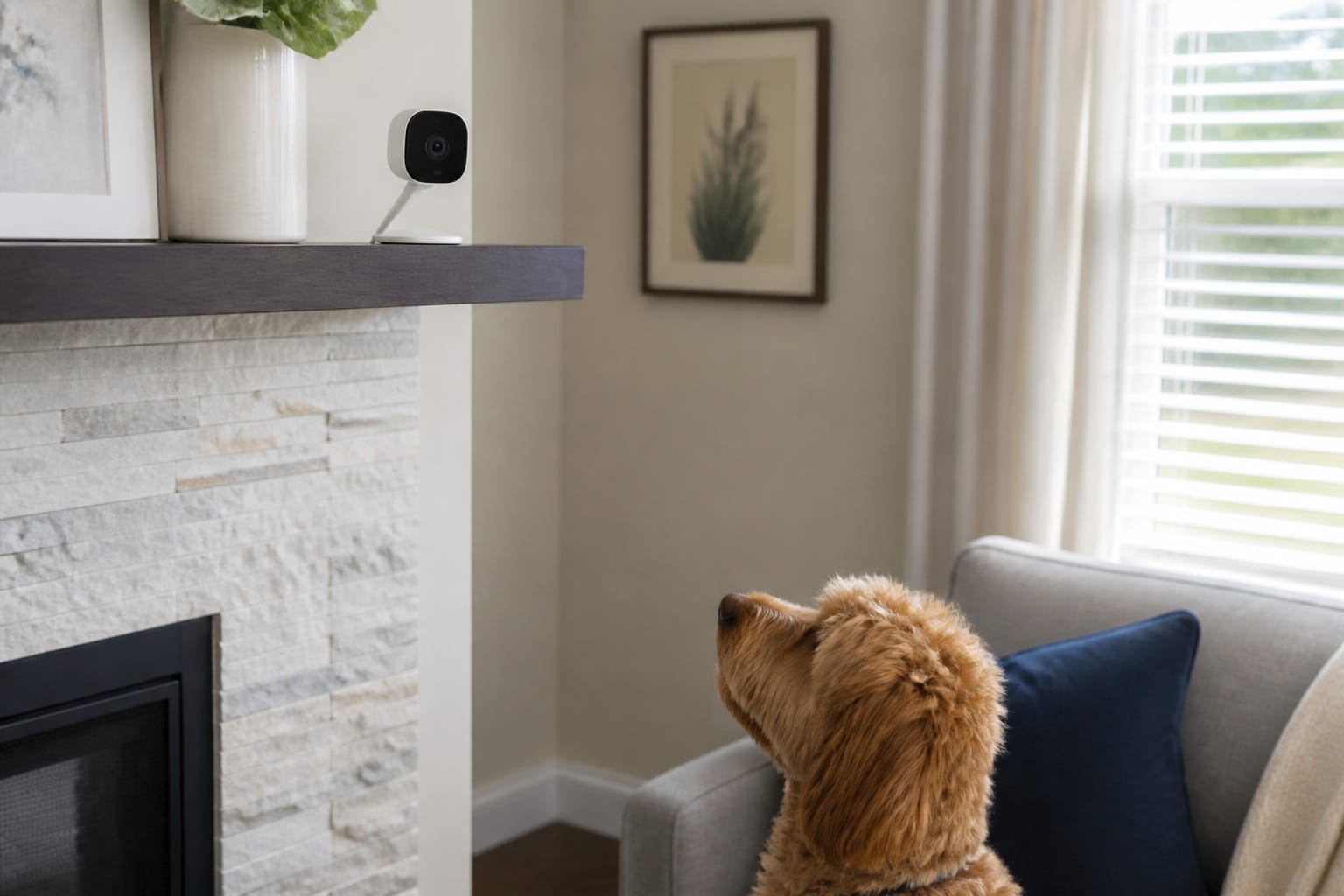
Pet cameras share the same underlying technology as home security cameras: night vision, motion alerts, two-way audio, and category-specific features. A treat-toss or dispenser function is the most-cited “actually gets used” feature, letting you deliver a reward remotely rather than just watching.
Two-way audio is genuinely useful for redirecting a barking dog or reassuring a nervous pet, though results vary by animal; some pets respond well to a familiar voice through a speaker, others show no reaction at all or a startled one.
Motion-triggered alerts are worth tempering expectations for pets, since a camera pointed at an active dog or cat generates far more motion notifications than a doorbell or a static room ever would; most people end up narrowing the motion zone or adjusting sensitivity within the first week to stop the notification fatigue.
If separation anxiety monitoring is the actual goal, a camera that logs activity or barking over time is more useful than one that pushes a live alert every time the pet moves.
Products Worth Considering

Pet Camera with Treat Tossing: Combination of the dog camera and treat dispenser (0.5L capacity, Recommend 7-15mm food size), you can fill in your fur kid’s favorite treats in the treat dispenser and toss a treat to them remotely via the phone app while you are not at home. Let your dog experience your virtual presence.

【Remote Treat Interaction & Virtual Companion】The 2-in-1 camera built in 0.5L capacity treat dispenser supports remote feeding of 7-15mm pet snacks via phone app. Reward your furry friend anytime, ease separation anxiety, and deliver love through "virtual companionship" even when you're away.
![Furbo 360° Dog Camera [Paid Plan Required to Activate]](https://m.media-amazon.com/images/I/41bxvqBF-iL._SL500_.jpg)
PEACE OF MIND: Keep your dog safe, healthy, and happy, even when you’re away. Get notified about barking, unusual activity, emergencies, and more with Furbo 360° and AI-powered Furbo Nanny—so you can relax knowing they’re safe and sound.
Using a Pet Camera to Watch a Sitter or Dog Walker: What’s Legal
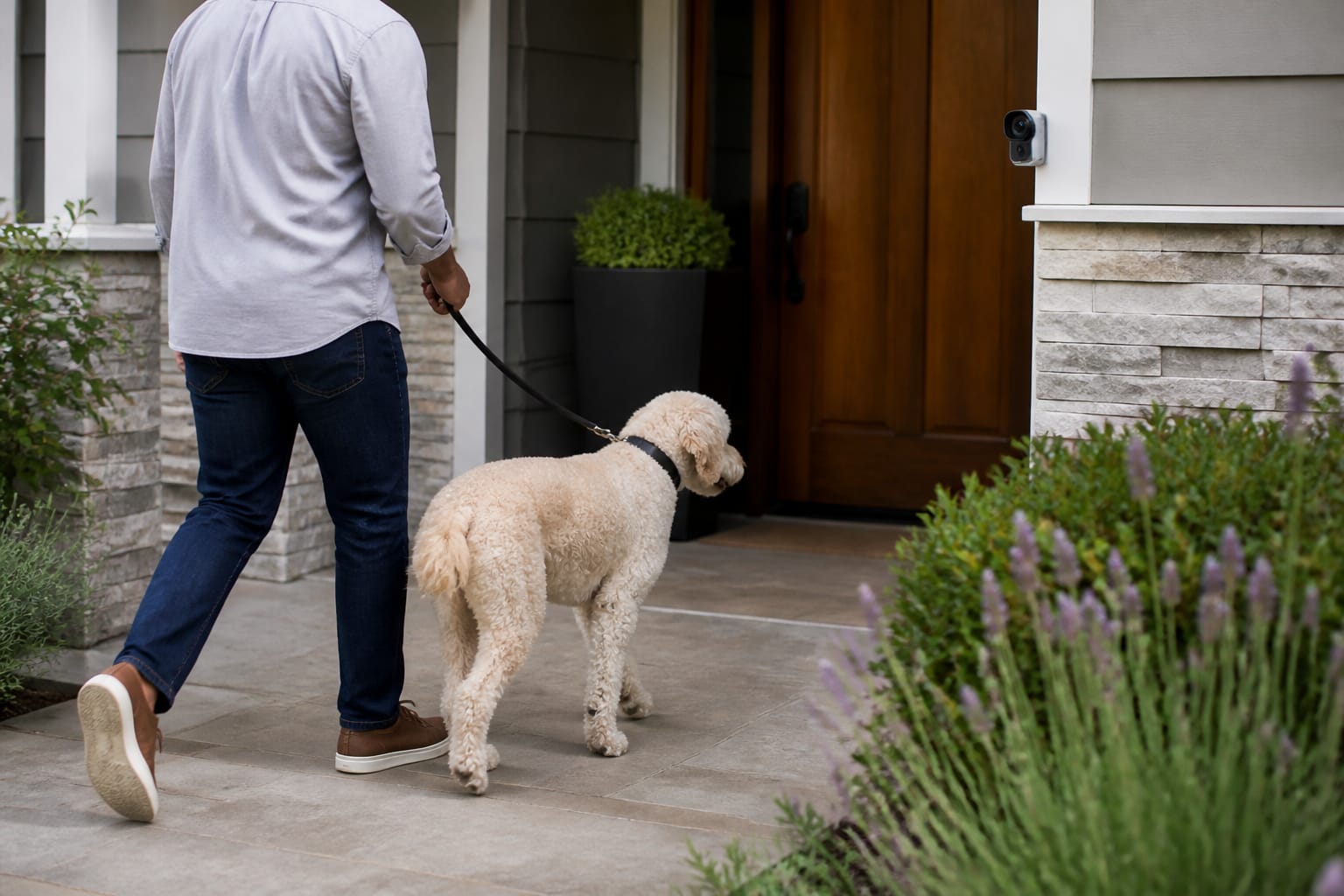
This is a common use case for pet cameras that it’s worth addressing directly. Recording video in your home, including in common areas while a pet sitter or dog walker is there, is legal in all 50 states without their consent, as long as the camera isn’t placed somewhere with a reasonable expectation of privacy, a bathroom being the clear example.
Audio is the part that gets legally complicated, the same all-party-consent issue covered in more depth in our video doorbell privacy and legal breakdown: roughly a dozen states require every party’s consent to record a private conversation, and a sitter’s phone call or a candid remark caught on an always-listening camera can cross that line in those states.
Practically, telling a sitter or walker the camera exists, even though it’s not legally required in most cases, tends to avoid the trust problem entirely and is standard advice from pet-sitting industry sources themselves.
If audio matters less to you than simply confirming the pet was fed and let out, disabling the microphone removes the more legally sensitive part while keeping the part you actually wanted.
Products Worth Considering

Live Stream from Anywhere with Pan/Tilt: Sharp and clear 1080p Full HD provides high quality video right in the palm of your hand. Camera is operated with the Tapo or Kasa App. 2.4 GHz Wi-Fi required.

1 - 4MP Resolution & Dual WiFi Bands - Arenti pet camera provides 2.5K 4MP ultra clear live stream which allows you to monitor pets, babies or elderly. This WiFi camera works on both 2.4GHz and 5GHz bands to provide stronger signal and faster WiFi connection.

360°Coverage with 2K Resolution - blurams security camera automatically tracks the motion if detect motion. Features in IR-CUT function to capture crisp videos and photos from the day to night, even in the dim condition. Turn on privacy mode to protect your privacy
So, Are They Worth It?

For most households with an irregular schedule or a pet on a specific feeding plan, yes, a reliable feeder is a genuinely useful purchase.
Prioritize battery backup, local scheduling that doesn’t depend on a live internet connection, and a dispensing mechanism that matches your specific kibble over any camera or app feature.
A pet camera is a nice-to-have for peace of mind and redirecting behavior, not a monitoring solution that replaces daily human attention, whether that attention comes from you or a sitter you trust.
For the bigger picture on prioritizing smart home purchases generally, our budget starter kit guide covers how to sequence spending without overbuying features you won’t use.
Frequently Asked Questions
Can I trust an automatic feeder while I’m away for a full weekend?
Only with battery backup, a reliable dispensing mechanism for your specific kibble, and ideally someone checking in physically at least once, even briefly. A feeder is a supplement, not a substitute for care. A jam, a dead battery, or an empty hopper becomes a real problem fast when no one notices.
Why does my automatic feeder keep jamming?
Almost always kibble size or shape relative to the feeder’s chute opening, not a defect. Oversized, star-shaped, or irregular kibble is the most common cause. Switching to a smaller, more uniform kibble specifically for automatic feeder use is a common and acknowledged workaround if your pet’s regular food causes jams.
Is it legal to use a pet camera to watch my dog walker or pet sitter?
Video recording in the common areas of your own home is legal in all 50 states without their consent. Audio recording is more legally complex, since roughly a dozen states require consent from everyone in a private conversation before it can be recorded. While not always legally required, telling the sitter or walker about the camera is standard advice to avoid trust issues entirely.
Do I need a weight-based feeder, or is a scoop-based one fine?
For a healthy pet at a stable weight, a standard volume-based feeder is generally fine. For a pet on a veterinarian-directed weight management or medical diet, where precise gram amounts matter, a weight-based feeder with a built-in scale is worth the extra cost, since kibble density varies enough by brand that volume measurements alone can drift from the intended amount.
How do I stop constant motion alerts from a pet camera?
Narrow the motion detection zone to the specific area you actually care about, and lower the sensitivity if your app allows it. An active pet triggers far more motion events than a doorbell or a static room, and most people adjust these settings within the first week specifically to cut down on notification fatigue.