
Which VR headset should you buy for gaming? It sounds like a simple question. It isn’t.
The right headset depends on what you already own. A PlayStation 5, a gaming PC, or nothing at all each point you toward a different answer. Pick wrong and you end up with blurry visuals, a headset that won’t connect to your hardware, or a game library that doesn’t match what you want to play.
Below are five headsets worth considering, what each one does well, and where each one makes you compromise.
Is the PlayStation VR2 the Best Choice for PS5 Owners?
If you own a PS5, yes, it’s the obvious place to start. The PSVR2 uses an OLED display with 2000 x 2040 pixels per eye and a 120Hz refresh rate. Visuals are 4K HDR with a 110 degree field of view. Colors are rich, blacks are deep, and motion stays smooth.
Four built-in cameras track your movement, and eye tracking follows where you look. Haptic feedback in the headset itself adds a small rumble during intense moments, and 3D Audio places sounds around you. The Sense controllers add adaptive triggers and finger touch detection for more natural hand gestures.
It weighs under 600 grams and connects to the console with a single USB-C cable. The trade-off is that cable. You are tethered, and you need a PS5 to use it.
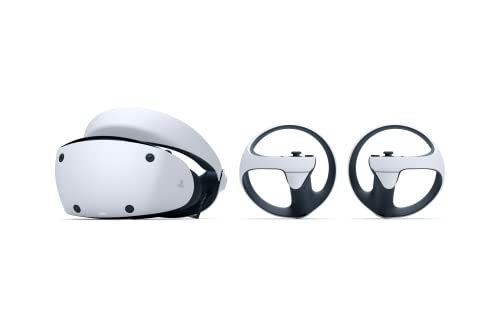
PlayStation VR2 Sense technology: Eye tracking. Headset feedback. 3D Audio. Highly intuitive controls – Haptic Feedback, Adaptive Triggers and Finger Touch Detection...
Why Is the Meta Quest 3 So Popular?
Because it does the most things well without asking for anything else. The Quest 3 is a standalone headset, so there’s no console, PC, or cable required to start playing.
It packs 2064 pixels across each eye, which is roughly 30% sharper than the Quest 2. Pancake lenses keep the image clear from edge to edge and make the headset slimmer. The Snapdragon XR2 Gen 2 chipset doubles the graphics power of the previous model.
The IPD wheel adjusts from 53mm to 75mm, so it fits most faces. Full-color passthrough lets you see your room while you wear it, which makes mixed reality games possible. The 512GB model has plenty of space for a large game library.
Battery life is the weak spot. Expect a little under two hours of active play, so keep a charging cable handy. You can also tether the Quest 3 to a gaming PC when you want PC VR titles.

CARDBOARD MONKENAUT — Get our best Gorilla Tag bundle yet with this Amazon exclusive deal. Purchase Meta Quest 3 to get exclusive items, including the Gorilla Space Program...
Is the Valve Index Still Worth It for PC Gamers?

For tracking accuracy, it’s still hard to beat. The Index relies on external lighthouse base stations that sweep your room with infrared lasers. The headset and controllers read those signals, which gives you precise tracking across a play space up to 32 feet wide.
The Index controllers carry 87 sensors each. They track individual fingers, grip pressure, and hand position, so you can open your hand completely and the game knows it. That matters most in simulation games and anything that rewards fine hand control.
The dual 1440 x 1600 LCD panels run at up to 144Hz. The cost is complexity. You need a capable gaming PC, you have to mount the base stations, and the total price climbs quickly.

HEADSET ONLY. (MAY NOT INCLUDE HEAD STRAP ADJUSTMENT PAD). Controllers and base station purchased seperately 5x IMPROVEMENT over first-generation PC VR HMDs.
What Makes the HTC Vive XR Elite Different?
Its design. The HTC Vive XR Elite works as a standalone headset, and you can also connect it to a VR-ready PC for low-latency PC VR games. No base stations are needed either way, because four wide field-of-view tracking cameras handle the tracking.
The display is 3840 x 1920 combined, about 19 pixels per degree, with up to a 110 degree field of view at 90Hz. Stepless IPD and diopter adjustments let you fine-tune the fit and focus until the image looks clear to your eyes. Full-color passthrough and a depth sensor support mixed reality, hand tracking lets you navigate with natural finger movements (support depends on the title), and built-in speakers handle the audio.
The battery is swappable and hot-swappable, with up to 2 hours of continuous power, so a spare lets you keep playing. This version also ships with the Deluxe Pack: the VIVE Face Gasket 2.0, Deluxe Strap, Temple Clips, and MR Gasket. It’s a strong pick if you want one headset for both standalone play and PC VR. The trade-off is the 90Hz refresh rate, lower than the 120Hz on the PSVR2.

Includes Deluxe Pack VR Accessories: VIVE Face Gasket 2.0, VIVE Deluxe Strap, VIVE Temple Clips, and VIVE MR Gasket. PC Gaming Headset: Bring captivating PC VR games to your...
Is the Meta Quest 3S Good Enough to Save Money On?

For most first-time buyers, yes. The Quest 3S starts at $299.99 and uses the same Snapdragon XR2 Gen 2 processor as the Quest 3, backed by 8GB of RAM. Games run the same. What changes is the display and optics.
It uses Fresnel lenses instead of pancake lenses, so you’ll see more glare. Resolution drops to 1832 x 1920 per eye, and the 96 degree field of view feels narrower. If you’ve never used VR, you may not notice. If you’ve used a Quest 3, you will.
You still get color passthrough, mixed reality, and access to Meta’s full game library. It supports a 120Hz refresh rate, weighs about 514 grams, and gets roughly 2.5 hours of battery life in active play.

CARDBOARD MONKENAUT — Get our best Gorilla Tag bundle yet with this Amazon exclusive deal. Purchase Meta Quest 3S to get exclusive items, including the Gorilla Space...
Wired or Wireless: Which Type of VR Headset Is Better?
Neither is better outright. It comes down to what you value in each play session.
Wired headsets like the PSVR2 and Valve Index lean on the power of a console or PC. That means sharper visuals, richer effects, and a connection with very little lag. Fast games like racing titles feel steadier, and that can help if you’re prone to motion sickness.
Standalone headsets like the Quest 3 give you freedom. No cables, no setup, and you can play in any room. They also suit fitness apps and active games well. The cost is some visual fidelity and a battery that needs charging, with the Quest 3 lasting under two hours in many sessions.
If you want top performance and PlayStation exclusives, go wired. If you want convenience, portability, and a wide app library, go wireless.
How Do You Choose the Right VR Headset for Your Setup?
Start with your platform. If you own a PS5, the PSVR2 is built for it. If you have a gaming PC, the Valve Index and a tethered Quest 3 both open up PC VR. If you have neither, a standalone Quest is the simplest way in.
Next, think about your space. Lighthouse tracking on the Index works best in a dedicated room-scale area. Inside-out tracking on the Quest 3 needs no external sensors, so it suits smaller rooms.
Then check your budget honestly. Wired headsets can demand a powerful PC or a console on top of the headset price. Standalone headsets include everything you need. The Quest 3S gets you mixed reality features for around $300.
Last, match the headset to your hardware, then decide on comfort and library size.
So Which VR Headset Should You Buy?
Here’s the short version.
On a budget? Get the Quest 3S. Want the best visuals on a PS5? Get the PSVR2. Need the most precise tracking on a PC? Get the Valve Index. Want one headset for wireless play and PC VR? Look at the HTC Vive XR Elite.
If you want one headset that balances features, price, and flexibility, the Quest 3 is the best all-around pick.
Frequently Asked Questions
Do I need a PC or console to use a VR headset?
Not always. The Meta Quest 3 and Quest 3S are standalone, so they run games on their own. The PSVR2 needs a PS5, and the Valve Index needs a gaming PC.
Which VR headset has the best picture quality?
It depends on what you mean by quality. The PSVR2 has the OLED display with deep blacks and rich color. The Valve Index and Quest 3 both offer sharp, high-refresh visuals, and the Quest 3 gets there with pancake lenses at a lower price.
Is the Quest 3S good enough, or should I spend more on the Quest 3?
The Quest 3S is good enough for most new users. You give up lens quality, resolution, and field of view, but not performance or game access. If visual clarity matters a lot to you, the Quest 3 is worth the extra money.
How long does a wireless VR headset battery last?
Plan on roughly two to two and a half hours of active play for the Quest 3 and Quest 3S. Plugging in a charging cable or battery pack extends a session.
Can VR headsets cause motion sickness?
They can, especially in fast-moving games. A smooth refresh rate and low latency help. Start with shorter sessions and take breaks until your body adjusts.
As an Amazon Associate I earn from qualifying purchases.


