Studio monitors are speakers designed to reproduce sound as accurately as possible, so that what you hear is what is on the recording. Regular home speakers are often tuned to sound pleasing, with extra bass or sparkle. Which you want depends on whether you are making music or just enjoying it. This guide explains the differences and how to choose.
Accuracy vs Flattery
A good studio monitor has a fairly flat frequency response, meaning it does not boost bass or treble. That reveals flaws in a mix, so producers can fix them before they reach listeners. Many consumer speakers are tuned to be flattering, with warmer bass and brighter highs, which can make bad mixes sound good and hide problems. Neither is wrong, but they serve different purposes. Our guide on what makes a speaker sound good covers neutral sound.
Powered Design
Most studio monitors are active, with built-in amplifiers matched to the drivers, so you need only a signal source and power. That keeps the setup simple and consistent. Regular home speakers are often passive and need a separate amplifier or receiver. See active vs passive speakers for how each works.
Products Worth Considering
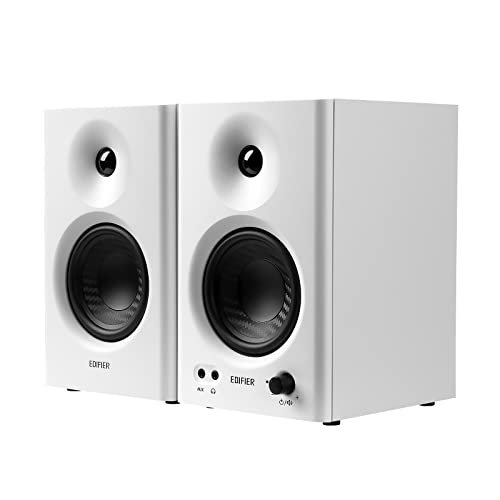
TRUE STUDIO MONITOR – Based on the highly reviewed Edifier bookshelf speakers, professionally fine-tuned to a near-flat responsive curve for artists and music creators.

TRUSTED STUDIO-QUALITY SOUND: True studio sound for music production, gaming, movies, streaming, and everyday audio. Sold as a complete stereo pair.

Latency Free Wired Connection - Engineered for zero-latency audio monitoring, these wired desktop speakers provide a pure, uninterrupted signal perfect for live streaming, gaming, podcasting, and studio work
Nearfield Listening
Monitors are usually designed for nearfield listening, meaning you sit about an arm’s length or a few feet away. Close listening reduces the effect of the room, which is important because most home studios are small and untreated. This also makes them well suited for desks and small rooms. Bookshelf-style hi-fi speakers also work well on a desk, but they are tuned differently.
Products Worth Considering
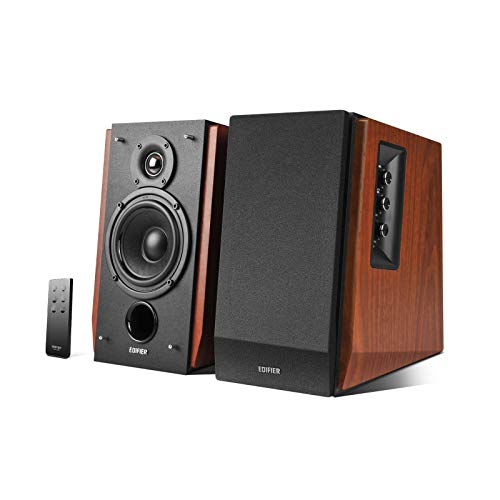
Built-in amplifier (33 watts x 2 speakers) so there is no need for outside amplifier or receiver—just plug into source and play

HONEST. Eris 4.5 near field studio monitors deliver studio-quality, accurate sound perfect for music production, hi-fi audio listening, or multimedia reference.
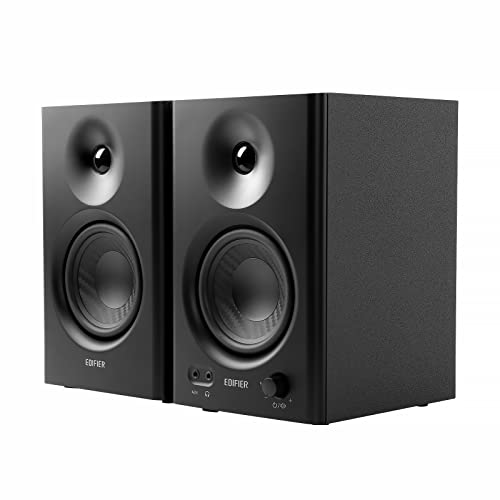
TRUE STUDIO MONITOR - Based on the highly rated Edifier bookshelf speakers professionally tuned to a responsive almost flat curve for artists and music creators.
Connections
Monitors typically offer balanced XLR or TRS inputs, which resist noise over longer cable runs, and sometimes RCA or 3.5mm inputs as well. Consumer powered speakers may use RCA, 3.5mm, optical, or Bluetooth. If you will connect an audio interface or mixer, balanced connections are an advantage. See whether expensive audio cables matter and whether you need a DAC or audio interface.
Products Worth Considering

Balanced cables have a separate braided shield to provide additional resistance to interference without modulating the interference into the signal.

Male XLR to 1/4 Cable: This balanced XLR male to 1/4 cable is perfect for interconnecting a wide range of audio equipment with an XLR connector and 1/4 inch TRS jack, such as studio monitors, mixers, audio interfaces, and other professional audio gear.
Male XLR to 1/4 Cable: This balanced XLR male to 1/4 cable is perfect for interconnecting a wide range of audio equipment with an XLR connector and 1/4 inch TRS jack, such as studio monitors, mixers, audio interfaces, and other professional audio gear.
The Room Matters More
A pair of accurate monitors in a bad room still gives misleading results. Hard walls, corners, and the wrong position can add bass buildup and reflections. Place the monitors at ear level, form a triangle with your head, and keep them away from walls. Read speaker placement and how to improve sound in a small room.
Can You Use Monitors for Regular Listening?
Yes. Many people use monitors as desktop speakers. Expect a more neutral sound than a typical consumer speaker, which some listeners love and others find less exciting. If you want deep bass for movies, you may still want a subwoofer, and monitors usually lack extras such as Bluetooth.
Which Should You Choose
Choose studio monitors if you record, mix, or produce, or want a neutral sound. Choose regular speakers if you mostly listen, watch movies, or want features like Bluetooth and built-in streaming. For DJs, see DJ gear for beginners for speaker choices.
Products Worth Considering

Bring your studio sound with you: Studio monitors designed for portability with 20 hours of battery life, robust design and lightweight build.
![SOUND FORGE Audio Studio 16 - The complete solution for recording, audio editing, restoration and mastering in one | Audio Software | Music Program | for Windows 10/11 [PC Online code]](https://m.media-amazon.com/images/I/41IasYLiIkL._SL500_.jpg)
The all-in-one audio editor: Everything you need to record, edit, restore and master audio.

Neutral, Detailed Sound – 5" Slatefiber woofer and 1" aluminum tweeter deliver accurate, balanced monitoring at any volume.
Frequently Asked Questions
Are Studio Monitors Good for Listening to Music?
Yes, if you like a neutral, detailed sound. They may sound less warm or bassy than consumer speakers, and some people prefer that accuracy.
Do Studio Monitors Need an Amplifier?
Most do not, because they have built-in amplifiers. Passive monitors exist and need an external amplifier, so check the specifications before buying.
What Size Studio Monitors Do I Need?
It depends on the room and distance. Smaller drivers suit small rooms and desks, and larger ones play lower bass but need more space. Bigger is not better in a small untreated room.
Can I Use Studio Monitors With a Phone or Bluetooth?
Yes, with the right input. A phone can connect through a 3.5mm cable or an adapter, and a small Bluetooth receiver can add wireless input. Bluetooth is not built in on most monitors.
Do I Need a Subwoofer With Studio Monitors?
Not necessarily. Many monitors play low enough for most music. A subwoofer helps with movies and electronic music, but it can also make a small room boomy. See whether you really need a subwoofer.