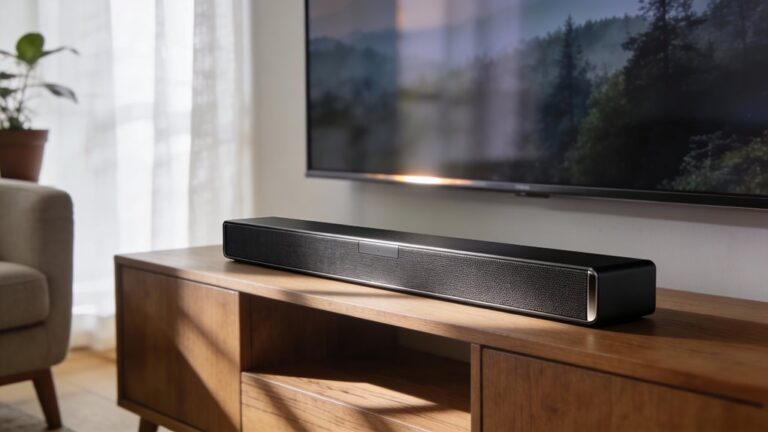
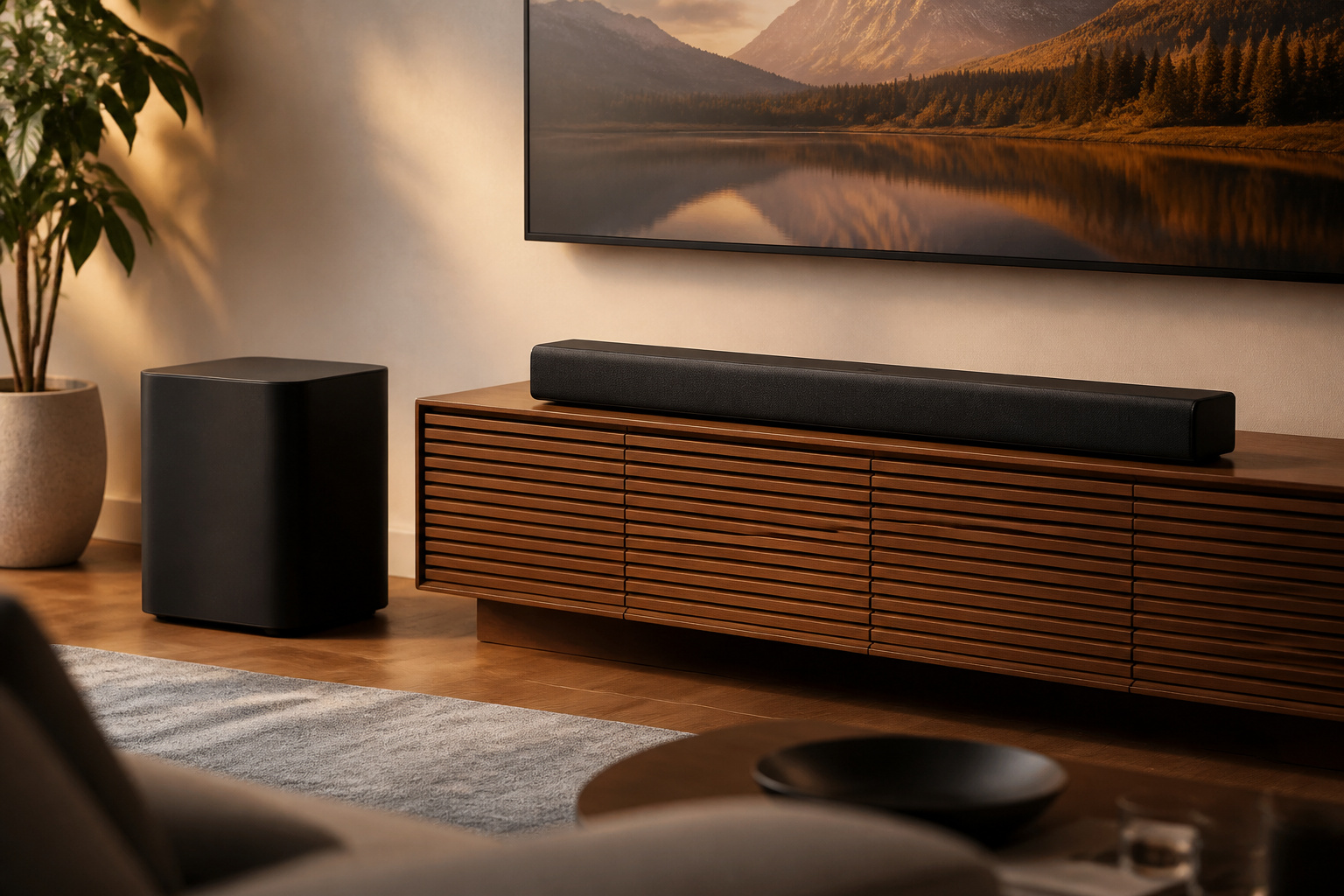
Nearly every TV sounds thin because its speakers have to fit inside a slim cabinet. A soundbar or a full home theater system can fix that, but each solves the problem differently.
This guide compares the two and explains what to look for in a soundbar, including dialogue clarity, subwoofers, Dolby Atmos, and small rooms.
How Soundbars and Home Theater Systems Differ
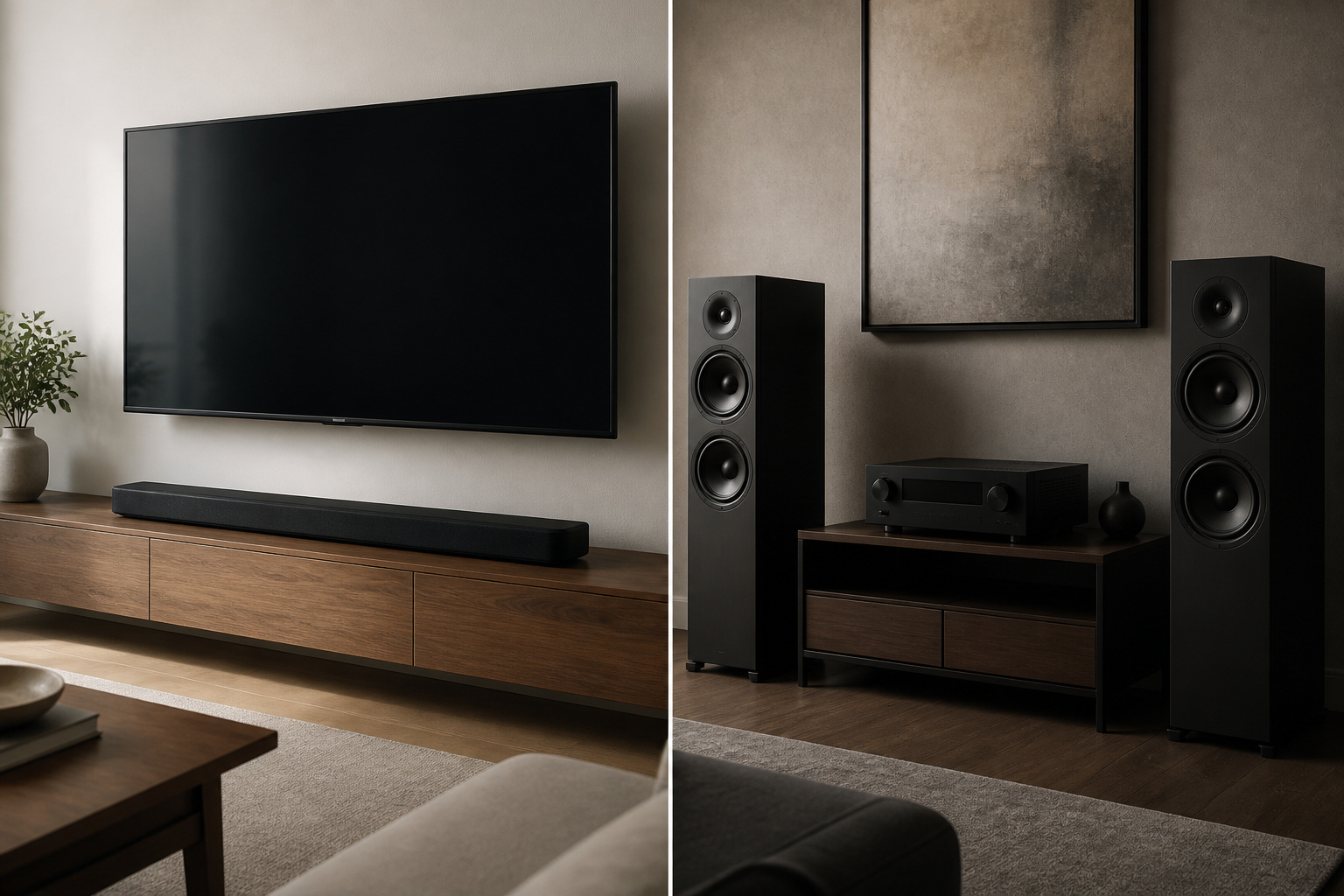
A soundbar is a single speaker, or a speaker plus a separate subwoofer, that sits under the TV. It is easy to set up, takes little space, and usually connects with one HDMI cable.
A home theater system uses separate speakers, typically a front left and right, a center channel, surround speakers, and a subwoofer, driven by an AV receiver. It requires more space and setup, but it delivers more accurate sound placement and more power.
When a Soundbar Is the Better Choice

Choose a soundbar if you want a big improvement over TV speakers without running wires or learning a receiver menu. Soundbars suit apartments, bedrooms, and living rooms where speaker placement is limited.
Models with wireless rear speakers or upfiring drivers can create a surprisingly wide soundstage, though they cannot match true rear speakers in a well-set-up room.
Recommended Products

New Dimensional Sound - Come home to the cinematic sound you’ve always wanted, and experience every heart-thumping, thrill-inducing, moment. With 4 channels backed by a booming wireless subwoofer and wireless rear speakers, this LG Soundbar delivers a big audio punch without taking up too much of your space—or budget. Dolby Digital and DTS Digital compatibility means you still get enhanced sound quality for all your shows, movies, music and more.

5.1 S-Series Sound Bar Fill your room with sound, bringing the movie theater experience into your home with just a single HDMI cable.
When a Home Theater System Makes Sense
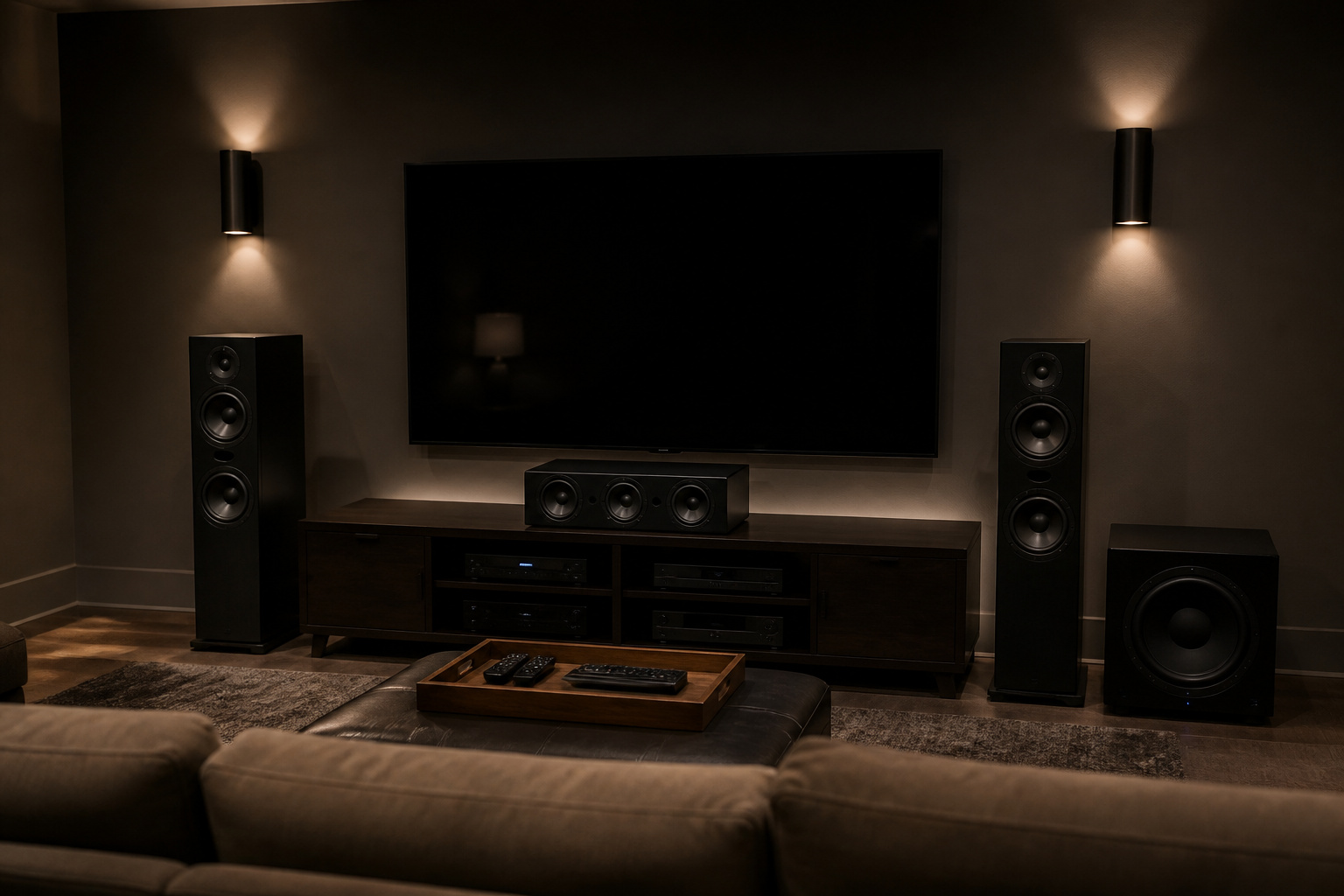
A separate-speaker system gives better separation, stronger bass, more headroom at high volume, and the ability to upgrade one part at a time. It is a better fit for a dedicated movie room or if you care about music as much as movies.
If you want to build one on a budget, see our guide to building a home theater on a budget, and for layout help, see speaker placement.
Recommended Products

Feel every note with a 600W power output

【40Wx4 Bookshelf Speakers and 75w Center Speaker】: The surround sound system features four high-power and full-range speakers, including one 3-inch passive center speakers and two pair of 3-inch passive bookshelf speakers(four speakers are identical), allowing you to experience stunning surround sound from all angles.

Wireless Subwoofer, Place It Anywhere: The wireless subwoofer connects to the soundbar without audio cables, giving you the freedom to place it anywhere in your room for flexible setup.
What to Look For in a Soundbar
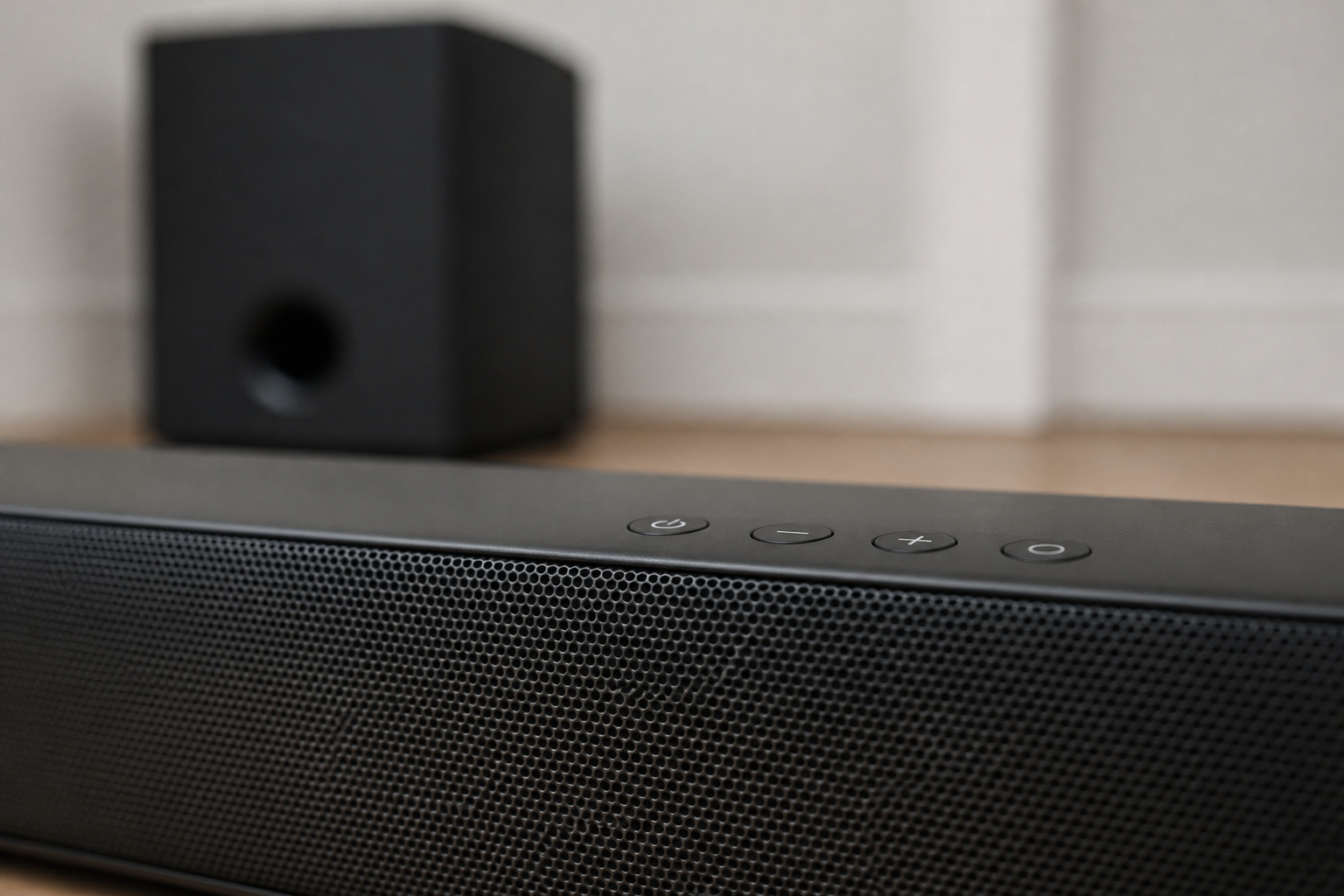
The most important soundbar features depend on what bothers you most about your TV’s sound.
For muffled dialogue, look for a model with a dedicated center channel or a dialogue enhancement mode. Many soundbars add voice-boost settings that make speech easier to follow at low volume.
If bass is the main issue, pick a soundbar with a separate wireless subwoofer, since a small bar cannot reproduce deep bass on its own. For movies, models with support for Dolby Atmos can add height effects, which work best with upfiring drivers and a reasonably low, flat ceiling; our Dolby Atmos explainer covers what to expect.
For small rooms, a compact bar of around 30 to 40 inches is plenty. If the room is tight, larger bars can sound lopsided. Confirm the bar fits under your TV without blocking the remote sensor; our soundbar placement tips help with this.
Recommended Products

Simplified 5.1ch Dolby Atmos Setup: Enjoy immersive 4D sound with real Dolby Atmos and 5.1-channel audio. Five built-in speakers, including two side-firing drivers, create wide surround without rear speakers. Precision DSP ensures <0.5 ms latency for smooth, theater-like sound. Setup takes less than 1 minute.

5.1.2ch Surround Sound System: A 5.1.2-channel system featuring up-firing speakers, surround sound, and a powerful subwoofer creates lifelike, multidimensional audio. Feel the Sky Around You—raindrops falling from above, helicopters circling overhead, thunder rumbling in all directions. Sound isn’t just around you, it engulfs you, as if the ceiling disappeared. This is Dolby Atmos: not just heard, but felt.

Why Choose TCL: TCL is a global leader in TVs and audio, combining innovative technology with reliable performance. Enjoy award-winning sound, durable design, and customer support that keeps your entertainment experience worry-free
Connections That Matter

Look for an HDMI eARC port, which carries high-quality audio formats from the TV to the soundbar and lets your TV remote control the volume.
If your TV has only an optical output, some features will be limited. See what eARC is and how to connect a soundbar to any TV.
Recommended Products

【HDMI 2.1 Certification】Only 1% of HDMI cables on the market have passed HDMI 2.1 certification. Scan with the QR code Scanner app for erification

【Support ARC/eARC on Audio】it is a standard HDMI 2.1 version cable,which are equipped with eARC technology. (Compatible with arc function) Supports the latest high-bitrate audio formats including DTS Master, DTS:X, Dolby Atoms, eARC. Provides enhanced support for your soundbar or AV receiver. Ultimate experience ,sounds like you were there.

HDMI eARC to Optical Cable(1.05m/41in): The eARC Audio Extractor connects to an eARC or ARC-compatible TV, allowing the TV's audio to be transmitted to a sound system via the converter's built-in optical SPDIF digital audio cable. The eARC audio converter Only for TV with “eARC” or ''ARC'' interface. Please make sure your TV supports the ARC feature and set the audio output to “ARC/EARC” and set the audio format to PCM
Frequently Asked Questions
Is a soundbar good enough for movies?
Yes, for most living rooms. A soundbar with a subwoofer is a large improvement over TV speakers, and Atmos models can add some immersion.
Do I need a subwoofer with a soundbar?
Not required, but a subwoofer adds the deep bass most soundbars cannot produce on their own. See whether you really need a subwoofer.
Can I add rear speakers to a soundbar later?
Some models support wireless rear speakers as add-ons. Check compatibility before buying, since options are limited by brand.
Which sounds better, a soundbar or a home theater system?
A properly set-up speaker system usually sounds better and scales further, but a soundbar is far simpler and fits more rooms.
Will any soundbar work with any TV?
Most connect via HDMI ARC or eARC, optical, or Bluetooth. Check your TV’s ports before buying so you get the best connection.